

What the Moon Is Really Made Of: Layers, Rocks, and Mysteries
For centuries, the Moon has captivated humanity’s imagination. From guiding ancient calendars to inspiring myths and legends, our closest celestial neighbor has always held a special place in our curiosity. But beyond its silvery glow lies a world full of secrets, hidden layers, mysterious rocks, and even traces of water, that scientists are only beginning to fully understand.
Today, thanks to lunar missions and advanced space technology, we can explore the Moon not just as a bright object in the night sky, but as a complex planetary body with a story of its own. In this blog, we’ll uncover what the Moon is really made of, layer by layer, and dive into some of the fascinating mysteries that continue to puzzle researchers. Whether you’re a space enthusiast, a student, or just curious about what lies beyond our planet, this journey to the Moon promises to be enlightening.
A Quick Overview of the Moon
The Moon is Earth’s only natural satellite, orbiting our planet at an average distance of about 384,400 kilometers (238,855 miles). Though it appears large in the night sky, it’s relatively small compared to Earth, with a diameter of just 3,474 kilometers (2,159 miles), roughly one-fourth the size of our planet. Its gravity is also weaker, about 1/6th of Earth’s, which is why astronauts could bounce and hop with such ease during the Apollo missions.
Understanding the Moon’s composition isn’t just a matter of curiosity; it’s essential for science and future space exploration. The Moon holds clues to the early history of the Earth-Moon system, the formation of rocky planets, and even the conditions necessary for life. By studying its surface and internal layers, scientists can better predict volcanic activity, meteorite impacts, and the availability of resources that might one day support lunar bases or mining operations.
With this context in mind, let’s dive deeper into what lies beneath the Moon’s surface, starting with its layered structure.
The Moon’s Layers
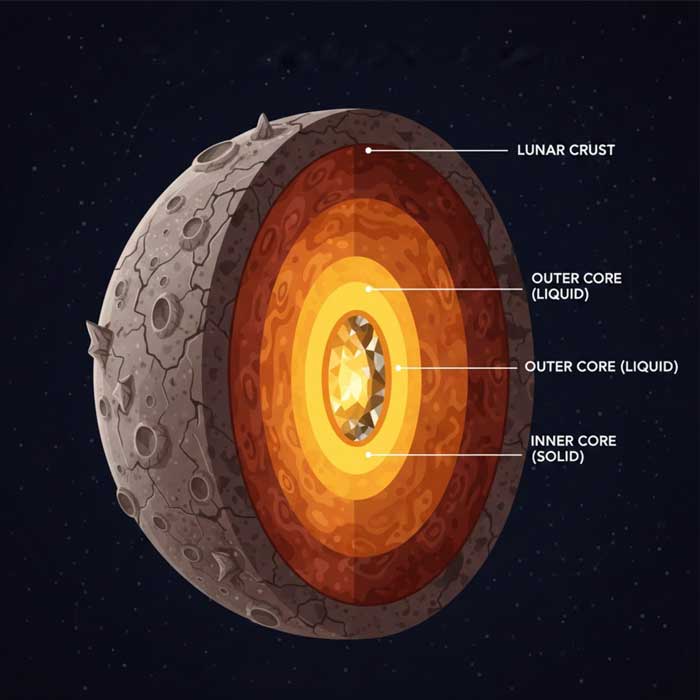
Just like Earth, the Moon isn’t a uniform ball of rock; it has distinct layers, each with unique characteristics. Understanding these layers helps scientists piece together the Moon’s history and formation.
Crust
The Moon’s outermost layer, the crust, is relatively thin, ranging from 30 to 50 kilometers (19–31 miles). It’s made primarily of anorthosite, a light-colored rock rich in calcium and aluminum, along with basalt in some regions formed from ancient volcanic activity. The crust also contains regolith, a layer of dusty, fragmented rock created by billions of years of meteorite impacts. The differences in the crust’s composition between the near side (facing Earth) and the far side give the Moon its unique “two-faced” appearance.
Mantle
Beneath the crust lies the mantle, which extends roughly 1,000 kilometers (620 miles) inward. The mantle is made mostly of silicate rocks rich in magnesium and iron. While much of it is solid, portions may have been partially molten in the Moon’s past, contributing to volcanic activity that formed the basaltic plains we call maria, the dark “seas” visible from Earth.
Core
At the heart of the Moon is a small core, estimated to be about 350 kilometers (220 miles) in radius, which is tiny compared to Earth’s. Evidence suggests the core is partially molten, composed mainly of iron with traces of sulfur and nickel. Though not active like Earth’s core, it plays a role in the Moon’s weak magnetic field and internal dynamics.
Together, these layers paint a picture of a Moon that is dynamic in its history, even if it appears still from afar. Next, we’ll explore the rocks and surface materials that make the Moon’s exterior so unique.
What the Moon’s Surface Is Made Of
The Moon’s surface may look smooth and uniform from Earth, but it’s a complex and fascinating landscape composed of dust, rocks, and ancient lava plains.
Regolith: The Moon’s Dusty Blanket
Covering most of the lunar surface is a layer called regolith, a fine, powdery mixture of dust, soil, and broken rock fragments. This layer was formed over billions of years by constant meteorite impacts that pulverized surface rocks. The regolith can be a few meters thick in some areas, making it soft and powdery, yet surprisingly sharp underfoot due to the jagged edges of tiny rock fragments.
Rocks on the Moon
The Moon’s surface is made primarily of two types of rocks:
- Basalt: These dark volcanic rocks cover the large plains known as maria, formed by ancient lava flows. They are rich in iron and magnesium.
- Anorthosite: Light-colored rocks that form the highlands, some of the Moon’s oldest surfaces, rich in calcium and aluminum.
These rocks tell a story of the Moon’s volcanic past and its violent history of meteorite bombardment.
Near Side vs. Far Side
Interestingly, the near side of the Moon (the side that always faces Earth) has more maria, giving it dark patches visible from Earth. In contrast, the far side has fewer maria and more highlands, resulting in a rugged, heavily cratered terrain. Scientists believe this difference is due to variations in crust thickness and ancient volcanic activity.
Next, we’ll look at how scientists know all this, from lunar missions to advanced satellite studies, revealing the methods behind our knowledge of the Moon.
How Scientists Know What the Moon Is Made Of
Understanding the Moon’s composition didn’t happen overnight; it’s the result of decades of exploration, experiments, and careful observation. Scientists use a combination of direct and remote methods to study our celestial neighbor.
Lunar Missions and Rock Samples
The most direct evidence comes from the Apollo missions (1969–1972), which brought back 382 kilograms (842 pounds) of lunar rocks and soil. Analysis of these samples in laboratories on Earth revealed the Moon’s primary rock types, basalt and anorthosite, and offered clues about its formation, volcanic activity, and age.
Robotic Missions
Soviet Luna missions, China’s Chang’e program, and NASA’s robotic orbiters have added valuable information. These missions help map the Moon’s surface, detect minerals, and measure temperature and radiation, providing insights without the need for humans on the ground.
Remote Sensing
Modern satellites use spectroscopy, radar, and laser altimetry to determine the Moon’s composition from orbit. By analyzing the light reflected from the surface, scientists can identify specific minerals and map variations in the crust and mantle.
Seismic Studies
Seismometers placed by Apollo astronauts recorded moonquakes, helping scientists understand the Moon’s internal structure, including the thickness of the crust, the nature of the mantle, and the existence of a small, partially molten core.
Thanks to these combined methods, we have a surprisingly detailed picture of the Moon’s interior and surface, setting the stage for discovering some of its most intriguing mysteries.
Mysteries and Surprising Discoveries
Even with decades of research, the Moon continues to surprise scientists. Its surface and interior hold mysteries that challenge our understanding of planetary science.
Water on the Moon
For years, the Moon was considered completely dry. Recent missions, however, have discovered water ice in permanently shadowed craters near the poles. This finding is not only fascinating scientifically but also has practical implications for future lunar bases, as water can be used for drinking, growing food, and even producing rocket fuel.
Moonquakes
While the Moon is geologically inactive compared to Earth, it still experiences moonquakes. Some are caused by tidal forces from Earth, others by meteorite impacts. These quakes suggest that parts of the Moon’s interior may still be partially molten, offering clues about its thermal history and internal dynamics.
Unusual Elements
The Moon contains elements rare on Earth, such as helium-3, which has potential as a fuel for future nuclear fusion energy. Other surprising finds include thorium and potassium in unexpected concentrations, hinting at a complex geological past.
Theories of the Moon’s Formation
One of the most widely accepted theories is the Giant Impact Hypothesis, which proposes that the Moon formed from debris after a Mars-sized body collided with the early Earth. Evidence from lunar rocks supports this idea, but questions remain, such as why the Moon’s isotopic composition is so similar to Earth’s.
These mysteries remind us that the Moon is more than a silent satellite; it’s a dynamic world with a story still being written.
Why the Moon’s Composition Matters
Understanding what the Moon is made of isn’t just an academic exercise; it has real-world implications for science, exploration, and even the future of humanity in space.
For Space Exploration
Knowing the Moon’s structure and resources is essential for planning lunar missions and bases. Water ice, minerals, and metals could support astronauts, reduce the need to transport supplies from Earth, and enable sustainable human presence on the Moon.
Understanding Earth’s History
The Moon acts as a time capsule for the early solar system. Its surface preserves a record of meteorite impacts and volcanic activity that has been erased on Earth due to tectonics and erosion. Studying lunar rocks helps scientists understand Earth’s formation and geological history.
Economic Potential
The Moon contains rare elements like helium-3, which could one day be used for clean nuclear fusion energy. Mining these resources may provide new opportunities for energy production and scientific research, making the Moon an attractive frontier for innovation.
Inspiring Scientific Curiosity
Beyond practical benefits, learning about the Moon fuels human curiosity and drives technological advancements. Lunar research pushes the boundaries of science, from geology to astronomy, and encourages a deeper appreciation of our place in the cosmos.
By studying the Moon, we not only uncover the secrets of our closest neighbor but also gain insight into the broader universe and the future possibilities for humanity beyond Earth.
Conclusion
The Moon is far more than a glowing companion in our night sky—it’s a complex world with layers, rocks, and mysteries that tell a story billions of years in the making. From its dusty surface and ancient volcanic plains to its partially molten core and hidden ice, the Moon continues to reveal secrets that deepen our understanding of the solar system and our own planet.
As scientists uncover more about its composition and history, the Moon also serves as a gateway for the future of space exploration, potential resource use, and technological innovation. Its mysteries inspire curiosity, spark imagination, and remind us that even a familiar object in the sky can hold wonders waiting to be discovered.
Next time you look up at the Moon, consider the rich story beneath its surface—a story of cosmic collisions, molten layers, and uncharted possibilities. The Moon isn’t just overhead; it’s a key to understanding our past, present, and future in the universe.