

What Is a Star, Really? What Are Stars Made Of?
More Than Tiny Lights in the Sky
When we look up at the night sky, stars appear as small, silent points of light scattered across the darkness. They seem distant, delicate, almost decorative. Yet this image could not be further from the truth. Every star we see is a massive, powerful object, burning with unimaginable energy and existing on a scale far beyond human experience.
For thousands of years, stars have guided travelers, inspired myths, and raised timeless questions. Ancient civilizations believed they were gods, spirits, or eternal fires fixed in the heavens. Today, science offers clearer answers, but the sense of wonder remains the same. Even with modern knowledge, stars still provoke one simple and fascinating question: What is a star, really?
Understanding what stars are made of and how they shine transforms the way we see the night sky. Those tiny lights are not decorations above us—they are ancient suns, some older than Earth itself, sending their light across space for millions or even billions of years before it reaches our eyes. To truly understand the universe, we must first understand these glowing hearts of the cosmos.
What We See vs. What a Star Truly Is
At first glance, stars seem calm and unchanging, gently flickering in the night sky. This twinkling effect, however, is not caused by the stars themselves. It happens because their light travels through Earth’s atmosphere, which bends and distorts it as it reaches our eyes. In reality, stars shine steadily and powerfully, without blinking at all.
Another illusion comes from distance. Stars appear small because they are incredibly far away, not because they are tiny. Even the nearest star beyond our Sun is so distant that its light takes years to reach Earth. Many of the stars we see are larger than our Sun; some so enormous that if placed at the center of our solar system, they would swallow the inner planets entirely.
When we look at the night sky, we are also looking back in time. Because light takes time to travel, the glow from a star may have begun its journey long before humans existed. Some stars we see tonight may no longer exist at all, yet their ancient light still reaches us. What we observe is not the star as it is now, but as it once was, turning the night sky into a living record of the universe’s past.
The Basic Definition of a Star
In simple terms, a star is a massive ball of hot gas held together by its own gravity. Unlike planets, stars produce their own light and heat, making them the true engines of the universe. Their brightness does not come from reflection, but from powerful processes taking place deep within their cores.
Gravity plays a central role in what makes a star a star. It pulls enormous amounts of gas inward, creating extreme pressure and temperature at the center. When these conditions become intense enough, a star is born. This balance between gravity pulling inward and energy pushing outward allows a star to remain stable for millions or even billions of years.
Our Sun is a perfect example of a star, ordinary in size, yet essential to life on Earth. Every star in the sky follows the same fundamental rules, whether it is smaller than the Sun or hundreds of times larger. Though they differ in color, size, and lifespan, all stars share this basic identity: self-luminous spheres powered by the forces of gravity and energy deep within.
What Are Stars Made Of?
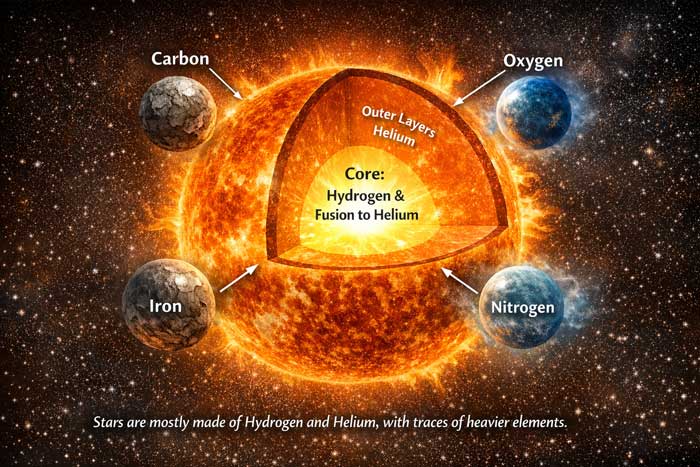
At their core, stars are made almost entirely of gas, primarily hydrogen and helium, the two lightest and most abundant elements in the universe. Hydrogen makes up the largest portion of a star’s mass, serving as the main fuel that allows it to shine. Helium is the second most common element, formed as hydrogen atoms combine deep inside the star.
In addition to these main ingredients, stars contain small amounts of heavier elements such as carbon, oxygen, nitrogen, and iron. Though these elements exist only in tiny percentages, they are incredibly important. They influence a star’s color, temperature, and evolution, and they also reveal clues about its age and origin. Younger stars tend to contain more heavy elements, inherited from earlier generations of stars that lived and died before them.
What makes this truly remarkable is that many of the elements found in our bodies were created inside stars. The oxygen we breathe, the calcium in our bones, and the iron in our blood were all forged in stellar interiors. In a very real sense, stars are not just distant objects in the sky; they are the cosmic factories that made life itself possible.
Discover the Magic of Morocco’s December Skies
The Fire Inside a Star: Nuclear Fusion Explained Simply
Deep inside every star lies its true power source: a process called nuclear fusion. This is not fire in the usual sense, no oxygen, no flames, but a powerful transformation that occurs under extreme heat and pressure. At the center of a star, temperatures reach millions of degrees, forcing hydrogen atoms to collide and merge.
When hydrogen atoms fuse together, they form helium. In this process, a tiny amount of mass is converted directly into energy. This energy is released as light and heat, pushing outward while gravity pulls inward. The balance between these two forces keeps the star stable and shining for an incredibly long time.
This continuous fusion is why stars glow for billions of years without burning out like a candle. As long as a star has hydrogen fuel in its core, it can continue producing energy. Every ray of starlight we see, whether in the desert sky or through a telescope, is the result of this invisible, ongoing reaction happening deep within a star’s heart.
Different Stars, Different Lives
Not all stars are the same. They vary in size, temperature, color, and lifespan, and these differences shape how they live and how they eventually die. Some stars are small and cool, glowing softly with a reddish light, while others are massive, extremely hot, and shine with a brilliant blue color.
A star’s color tells an important story. Red stars are cooler and often smaller, burning their fuel slowly and living for trillions of years. Yellow stars, like our Sun, have moderate temperatures and balanced lifespans. Blue stars are the hottest and most massive, burning their fuel at an incredible rate and living fast, dramatic lives that may last only a few million years.
Mass is the key factor that determines a star’s destiny. Small stars age gently and fade quietly, while massive stars live intensely and often end in spectacular explosions. From calm, long-lived dwarfs to short-lived giants, each star follows a unique path shaped by its size and inner power.
The Life Cycle of a Star
Every star follows a life cycle that begins long before it ever shines. Stars are born inside vast clouds of gas and dust called nebulae. Over time, gravity pulls this material together, forming a dense core that heats up until nuclear fusion begins. At that moment, a new star is born.
For most of its life, a star exists in a stable phase where it steadily converts hydrogen into helium. This stage can last millions or even billions of years, depending on the star’s size. During this time, the star shines consistently, maintaining a balance between inward gravity and outward energy.
When a star runs out of hydrogen fuel, its fate changes dramatically. Smaller stars expand into red giants before gently shedding their outer layers and fading into white dwarfs. Larger stars undergo far more violent endings, exploding as supernovae and scattering elements across space. These endings are not true endings at all; they plant the material needed for future stars, planets, and life to form.
Are Stars Alive? A Human Perspective
Stars are not alive in the biological sense, yet we often describe them as if they were. We speak of their birth, their lives, and their deaths, using language usually reserved for living beings. This is because stars follow a natural cycle that feels familiar and deeply human.
Like living things, stars change over time. They grow, age, and eventually transform into something new. They consume fuel, respond to their environment, and leave behind traces of their existence. This resemblance makes it easier for us to connect emotionally with objects that are otherwise distant and immense.
Seeing stars through this human lens does not diminish the science; it enhances our understanding. It reminds us that the universe is dynamic, not static. When we look at the stars, we are not just observing distant objects; we are witnessing ongoing processes that mirror the rhythm of life itself.
Stars and Us: Why They Matter
Stars are not only distant wonders in the sky, but they are also deeply connected to our own existence. Inside their cores, stars create the elements that make planets, oceans, and life possible. Without stars, there would be no carbon for life, no oxygen to breathe, and no iron to strengthen our world.
When massive stars die in powerful explosions, they release these elements into space. Over time, this material becomes part of new stars, planets, and eventually living beings. This is why scientists say, “We are made of stardust.” It is not a metaphor, but a scientific truth rooted in the life and death of stars.
Beyond science, stars have always guided humanity. They helped travelers cross deserts and oceans, shaped calendars and seasons, and inspired myths and beliefs across cultures. Even today, looking at the stars connects us to our past and reminds us of our place in a vast, shared universe.
Seeing Stars with New Eyes
Once we understand what stars truly are, the night sky changes forever. Stars are no longer distant decorations but powerful suns, each with its own story unfolding across time. Knowing that their light has traveled for millions of years gives every moment of stargazing a deeper meaning.
Dark, open places, far from city lights, offer the best opportunity to experience this connection. In environments like the desert, the sky reveals its true depth, with countless stars shining clearly against the darkness. Each one represents immense energy, ancient history, and cosmic creation.
Looking up with this awareness turns stargazing into more than observation; it becomes an experience of perspective. The universe feels larger, yet more intimate, reminding us that we are part of something vast, beautiful, and endlessly fascinating.
Ancient Light, Endless Wonder
Stars are among the oldest objects we can see, yet they continue to spark the same curiosity they did for our ancestors. They are massive spheres of gas, powered by fusion, creating light, heat, and the very elements that shape the universe. Understanding what a star is does not make it less magical; it makes it more meaningful.
Each point of light in the night sky carries a story of creation, transformation, and time. Some stars are just beginning their journey, while others are sending us their final glow. In every case, we are witnessing ancient light traveling across unimaginable distances to reach us.