
Different Types of Telescopes for Stargazing — And Where Each One Works Best
Why Choosing the Right Telescope Matters
Stargazing is one of the most powerful ways to connect with the universe, but the experience can change dramatically depending on the telescope you use. Many beginners assume that a bigger or more expensive telescope automatically means better views, yet this is not always true. The right telescope depends on what you want to observe and, just as importantly, where you plan to observe from.
A telescope designed for viewing the Moon and planets from a city balcony will perform very differently from one intended for exploring distant galaxies under dark desert skies. Factors such as light pollution, portability, ease of use, and optical design all play a major role in what you will see through the eyepiece.
Some telescopes excel at delivering sharp, high-contrast images of planets, while others are built to collect as much light as possible to reveal faint nebulae and galaxies. There are also modern, smart telescopes that guide you automatically across the night sky, making astronomy accessible even for complete beginners.
Understanding the main types of telescopes used for stargazing and knowing where each one works best helps you make an informed choice and ensures a more rewarding experience. Whether you are observing from a city rooftop, a quiet countryside, or beneath the clear, star-filled skies of the desert, choosing the right telescope transforms stargazing from a simple look at the sky into a true cosmic journey.
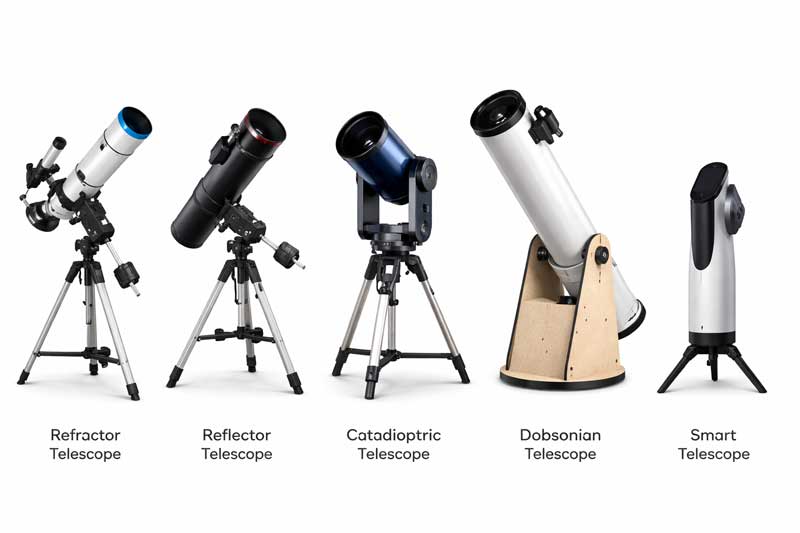
1. Refractor Telescopes – Ideal for Beginners and Planet Observation
Refractor telescopes are one of the oldest and simplest types of telescopes used in astronomy. They work by using glass lenses to bend and focus incoming light, producing clear and high-contrast images. Because of their straightforward design and reliability, refractor telescopes are often recommended for beginners.
One of the biggest advantages of refractor telescopes is their image sharpness. They excel at observing bright objects in our solar system, making them perfect for studying the Moon’s craters, Jupiter’s cloud bands, Saturn’s rings, and the phases of Venus. The images are crisp and stable, which makes them very satisfying for visual observation.
Where Refractor Telescopes Work Best
Refractor telescopes perform well in urban and suburban environments where light pollution is present. Since planets and the Moon are bright objects, they are less affected by artificial light. This makes refractors a great choice for:
-
City balconies and rooftops
-
Home backyards
-
Schools and educational settings
They are also well-suited for travelers who want a telescope that is easy to transport and quick to set up.
Why Choose a Refractor Telescope
-
Very easy to use
-
Minimal maintenance (no mirror alignment needed)
-
Sharp, high-contrast images
-
Durable and long-lasting
Limitations
Despite their strengths, refractor telescopes are not ideal for observing faint deep-sky objects like distant galaxies or nebulae. Larger refractors that can collect more light tend to be expensive and heavier.
Overall, refractor telescopes are perfect for casual stargazers, beginners, and anyone interested in planetary observation, especially when observing from light-polluted areas.
2. Reflector Telescopes – Best for Deep-Sky Exploration
Reflector telescopes use curved mirrors instead of lenses to collect and focus light. This design allows them to gather much more light than refractor telescopes of the same price, making them especially powerful for observing faint and distant objects in the universe.
Because of their strong light-gathering ability, reflector telescopes are widely used by amateur astronomers who want to explore beyond the solar system. Through a reflector telescope, observers can see star clusters filled with thousands of stars, glowing nebulae where stars are born, and distant galaxies millions of light-years away.
Where Reflector Telescopes Work Best
Reflector telescopes perform best under dark skies, where light pollution is minimal. They are ideal for:
-
Rural countryside locations
-
Mountain areas
-
Deserts and dark-sky reserves
In places like deserts, where the air is dry and skies are exceptionally clear, reflector telescopes reveal stunning deep-sky details that are nearly invisible from cities.
Why Choose a Reflector Telescope
-
Excellent for deep-sky objects
-
Large apertures at an affordable price
-
No color distortion from lenses
-
Widely available in many sizes
Limitations
Reflector telescopes require regular collimation, meaning the mirrors need to be aligned correctly for best performance. They are also bulkier and less convenient for quick observing sessions or travel.
Reflector telescopes are ideal for serious stargazers and deep-sky enthusiasts who have access to dark skies and want powerful views of the universe beyond our solar system.
3. Catadioptric Telescopes – Compact, Versatile, and Travel-Friendly
Catadioptric telescopes combine lenses and mirrors in a single optical system, offering a powerful yet compact design. The most common types are Schmidt-Cassegrain and Maksutov-Cassegrain telescopes. These models are popular among both amateur astronomers and astrophotographers because they balance performance, portability, and versatility.
Thanks to their folded light path, catadioptric telescopes provide a long focal length in a short tube, allowing for high magnification without requiring a large, heavy structure. This makes them excellent all-round telescopes capable of observing a wide range of celestial objects.
Where Catadioptric Telescopes Work Best
Catadioptric telescopes are well suited for mixed observing environments, including:
- Backyards in suburban areas
- Travel and mobile stargazing trips
- Desert and rural locations
- Astrophotography setups with tracking mounts
Their compact size makes them easy to transport, while their optical power allows them to perform well under dark skies and reasonably well in light-polluted areas.
Why Choose a Catadioptric Telescope
- Compact and portable design
- Suitable for planets, Moon, and deep-sky objects
- Excellent for astrophotography
- Compatible with computerized tracking systems
Limitations
Catadioptric telescopes can take longer to cool down to outdoor temperatures, which may affect image quality at the beginning of an observing session. They are also generally more expensive than basic reflector or refractor telescopes.
Overall, catadioptric telescopes are ideal for stargazers who want one telescope that can do a bit of everything, especially those who travel or enjoy both visual observing and astrophotography.
Discover the Magic of Morocco’s December Skies
4. Dobsonian Telescopes – Powerful Viewing Under Dark Skies
Dobsonian telescopes are a specialized type of reflector telescope mounted on a simple, ground-based altazimuth mount. Their design focuses on maximizing aperture size while keeping the structure easy to use and affordable. Because of this, Dobsonians are among the most popular telescopes for visual deep-sky observation.
What makes Dobsonian telescopes stand out is their ability to collect an impressive amount of light. Large Dobsonians reveal breathtaking views of the Milky Way, faint galaxies, expansive nebulae, and rich star fields that smaller telescopes cannot easily show.
Where Dobsonian Telescopes Work Best
Dobsonian telescopes truly shine in dark-sky environments, where light pollution is minimal. They are best used in:
- Deserts with clear, dry air
- Remote countryside areas
- National parks and dark-sky reserves
In open landscapes like deserts, Dobsonians allow observers to experience the night sky in its most natural and spectacular form.
Why Choose a Dobsonian Telescope
- Large aperture for superior deep-sky views
- Simple and intuitive manual operation
- Excellent value for money
- Minimal setup time
Limitations
Dobsonian telescopes are typically large and heavy, making them less suitable for travel or small spaces. They are also not ideal for astrophotography, as their manual mounts lack precise tracking.
Dobsonian telescopes are perfect for deep-sky lovers, astronomy clubs, and desert stargazing experiences, where space, darkness, and clear skies allow their full potential to be realized.
5. Smart & Portable Telescopes – Modern Stargazing Anywhere
Smart and portable telescopes represent the newest generation of stargazing technology. These telescopes are equipped with GPS, automated tracking, and smartphone connectivity, allowing users to locate and observe celestial objects with minimal effort. By pairing the telescope with a mobile app, even complete beginners can explore the night sky with confidence.
Unlike traditional telescopes that require knowledge of star maps and manual alignment, smart telescopes automatically identify stars, planets, nebulae, and galaxies. Many models also stack images digitally, making faint objects more visible even under light-polluted skies.
Where Smart Telescopes Work Best
Smart and portable telescopes are designed for flexibility and convenience, making them ideal for:
- Urban and city environments
- Backyards with heavy light pollution
- Travel and quick stargazing sessions
- Educational events and group experiences
They are especially useful in cities, where traditional deep-sky observation is limited, as their technology helps overcome the effects of artificial light.
Why Choose a Smart Telescope
- Extremely easy to use
- Perfect for beginners and families
- Works well in light-polluted areas
- Excellent for sharing images digitally
Limitations
Smart telescopes rely on batteries, software, and mobile devices, which can limit observing time. They are also less focused on traditional visual observing through an eyepiece, which some experienced astronomers prefer.
Smart and portable telescopes are ideal for casual stargazers, travelers, and educational experiences, bringing astronomy to anyone, anywhere.
Where to Use Each Telescope Type – Quick Comparison
Choosing the right telescope depends not only on the object you want to observe, but also on where you plan to observe from. Light pollution, space, portability, and sky quality all affect performance. The comparison below highlights where each telescope type works best.
Best Telescope by Location
| Observing Location | Best Telescope Type | Why It Works Best |
|---|---|---|
| City / Urban Areas | Refractor / Smart Telescope | Planets and Moon are bright; smart tracking helps overcome light pollution |
| Suburban Areas | Refractor / Catadioptric | Balanced performance for planets and some deep-sky objects |
| Backyard Observing | Catadioptric / Reflector | Versatile and powerful with enough space for setup |
| Rural Countryside | Reflector / Dobsonian | Darker skies allow deep-sky objects to shine |
| Desert & Mountains | Dobsonian / Large Reflector | Exceptional sky clarity reveals galaxies and nebulae |
| Travel & Mobile Use | Refractor / Smart Telescope | Lightweight, compact, and quick to set up |
| Educational & Group Events | Smart Telescope / Dobsonian | Easy sharing and wide-field views |
Why Location Matters
A small telescope under dark desert skies can outperform a large telescope used in a brightly lit city. Dark skies reduce glare, improve contrast, and reveal faint objects that are otherwise invisible. This is why deserts and remote areas are considered some of the best places on Earth for stargazing.
Understanding this relationship between telescope type and observing environment ensures better results and a more satisfying stargazing experience.
How to Choose the Right Telescope for You
With so many telescope options available, choosing the right one can feel overwhelming. The best telescope is not necessarily the biggest or the most expensive; it’s the one that fits your goals, experience level, and observing location.
1. Define What You Want to Observe
Start by asking yourself what excites you most about the night sky:
-
Moon and planets → Refractor or catadioptric telescope
-
Galaxies and nebulae → Reflector or Dobsonian telescope
-
A mix of everything → Catadioptric telescope
-
Casual or educational viewing → Smart telescope
2. Consider Where You Will Observe
Your observing location plays a major role in telescope performance:
-
City or light-polluted areas: Refractor or smart telescope
-
Suburban areas: Refractor or catadioptric
-
Dark skies (desert, countryside, mountains): Reflector or Dobsonian
Clear, dark skies can dramatically improve what you see, sometimes more than upgrading to a larger telescope.
3. Think About Portability and Storage
If you plan to travel, attend stargazing events, or have limited storage space:
-
Choose a compact or lightweight telescope
-
Catadioptric and smart telescopes are excellent for mobility
-
Large Dobsonians are better for permanent or semi-permanent setups
4. Match the Telescope to Your Experience Level
-
Beginners: Refractor or smart telescope
-
Intermediate users: Catadioptric or medium-sized reflector
-
Advanced observers: Large Dobsonian or astrophotography-ready systems
Ease of use encourages regular stargazing, which is more important than technical complexity.
5. Set a Realistic Budget
A modest telescope used often under good skies will always outperform an expensive one that stays unused. Invest in:
-
A stable mount
-
Quality eyepieces
-
Basic accessories like star charts or apps
Choosing wisely ensures a rewarding and long-lasting stargazing journey.
Stargazing Is About the Experience
Stargazing is not only about telescopes; it is about the experience of connecting with the universe. While choosing the right telescope can enhance what you see, the real magic happens when clear skies, quiet surroundings, and curiosity come together.
A simple telescope under dark, unpolluted skies can reveal more wonders than an advanced setup used in a brightly lit city. This is why locations like deserts and remote landscapes are considered some of the best places on Earth for stargazing. The absence of artificial light allows the Milky Way to stretch across the sky, galaxies to emerge from the darkness, and nebulae to glow with remarkable detail.
Whether you are a beginner observing the Moon for the first time, a traveler exploring the stars during a desert night, or an experienced observer hunting distant galaxies, there is a telescope suited to your journey. The key is to choose equipment that matches your environment, interests, and level of experience.
In the end, stargazing is about wonder, patience, and discovery. With the right telescope and the right location, the night sky becomes more than something you look at; it becomes something you truly experience.