

Astronomers Discover Mysterious ‘Iron Bar’ Piercing the Ring Nebula
The cosmos never ceases to surprise us. Astronomers have recently uncovered a bizarre and unexpected feature within one of the most famous planetary nebulae in the sky, the Ring Nebula, also known as Messier 57. Amid its iconic glowing clouds of gas and dust, scientists have spotted what appears to be a mysterious “iron bar” stretching across the nebula. This phenomenon challenges our understanding of how stars die and disperse their elements. This strange discovery has left researchers both puzzled and intrigued, offering a tantalizing glimpse into the hidden complexities of our universe.
What is the Ring Nebula?
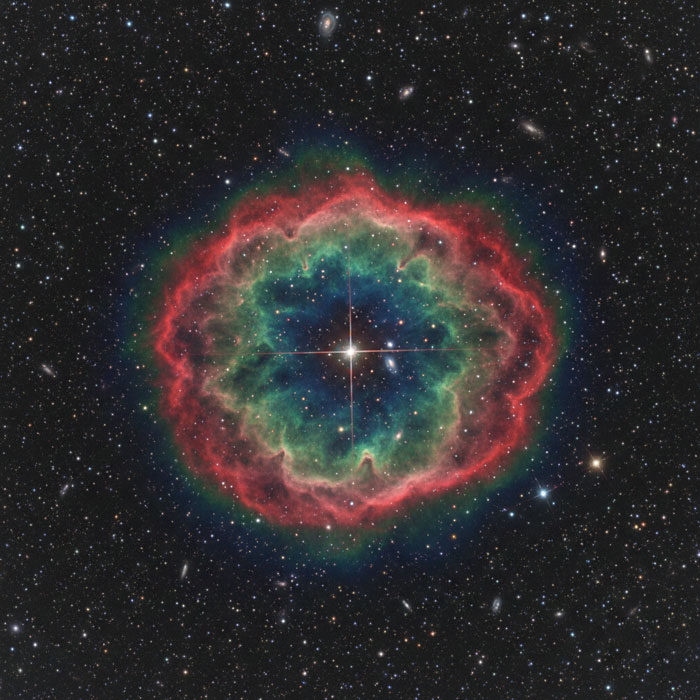
The Ring Nebula, also known as Messier 57, is one of the most famous and easily recognizable planetary nebulae in the night sky. Located about 2,300 light-years away in the constellation Lyra, it appears as a glowing, colorful ring of gas and dust when observed through a telescope. Despite its name, it’s not a ring in the traditional sense; it’s actually a shell of ionized gas expelled by a dying star at the center.
Planetary nebulae like the Ring Nebula are formed during the final stages of a star’s life. As the star exhausts its nuclear fuel, it sheds its outer layers, leaving behind a hot core called a white dwarf, which illuminates the surrounding gas. Over centuries, the gas expands, creating the breathtaking shapes and vibrant colors astronomers love to study.
The Ring Nebula has been observed for centuries, first cataloged in 1779 by Antoine Darquier de Pellepoix, and has served as a window into the life cycle of stars. Yet, even in such a well-studied nebula, the recent discovery of a strange “iron bar” proves that the universe still holds surprises waiting to be uncovered.
The Discovery of the ‘Iron Bar’
Astronomers recently detected a striking and unexpected feature within the Ring Nebula: a straight, narrow structure that resembles an “iron bar” cutting across the nebula’s familiar circular glow. Using advanced space telescopes and spectroscopy techniques, scientists were able to analyze the light coming from this feature and found hints of iron-rich material, a surprising find in a planetary nebula.
The “iron bar” appears as a thin, elongated filament that stands out against the swirling clouds of hydrogen and helium gas. Its orientation and composition are unlike anything previously observed in the Ring Nebula, sparking curiosity and debate in the astronomical community.
While the exact origin of this mysterious structure is still under investigation, researchers believe it may be connected to magnetic fields, stellar winds, or remnants of the star’s internal layers expelled in a highly directional manner. This discovery challenges previous assumptions about the uniformity of material ejected by dying stars and opens a new window into the complexities of stellar evolution.
Discover the Stars Like Never Before – Stargaze in Morocco!
Why It’s Mysterious
Finding an iron-rich structure in the Ring Nebula is puzzling for astronomers because planetary nebulae are typically dominated by lighter elements like hydrogen, helium, carbon, and nitrogen. Iron is usually created deep inside massive stars and released during supernova explosions, not in the gentle death of smaller stars that form planetary nebulae like Messier 57.
The “iron bar” raises several intriguing questions:
- How did the iron end up in such a straight, concentrated filament?
- Could strong magnetic fields be shaping the material in unusual ways?
- Is this a leftover piece from the star’s core, or evidence of a previously unknown stellar process?
Compared to other planetary nebulae, the Ring Nebula is well-studied and considered fairly typical, making the presence of this iron feature even more surprising. Scientists are now exploring new models of stellar evolution and gas dynamics to explain how such an unusual structure could form.
This discovery not only challenges current theories but also reminds us that even familiar cosmic objects can hold unexpected secrets, waiting to be unveiled by ever-more-sensitive instruments.
Implications for Astronomy
The discovery of the mysterious “iron bar” in the Ring Nebula could have far-reaching implications for our understanding of stellar evolution. Planetary nebulae are key laboratories for studying the life cycle of stars like our Sun, and unusual features like this challenge astronomers to rethink long-held assumptions.
Some potential implications include:
- New insights into stellar deaths: The presence of iron in a planetary nebula suggests that some stars may eject heavier elements in ways previously unobserved.
- Magnetic field dynamics: The straight, narrow shape of the iron filament hints at magnetic forces influencing the ejected gas, offering clues about how stellar magnetic fields behave in dying stars.
- Refining models of nebula formation: The discovery encourages scientists to update computer models and simulations to account for anomalies like this, improving predictions for other planetary nebulae.
- Clues to the chemical evolution of galaxies: Understanding how elements like iron are dispersed into space helps astronomers trace the enrichment of the interstellar medium, a critical factor in the formation of new stars and planets.
In short, this discovery is not just a curiosity; it could reshape how we think about the composition, dynamics, and evolution of dying stars.
Expert Opinions
The discovery of the “iron bar” has captured the attention of astronomers worldwide, prompting a mix of excitement and cautious speculation.
- Dr. Emily Petrova, an astrophysicist studying planetary nebulae, remarked:
“Finding an iron-rich filament in the Ring Nebula was completely unexpected. It challenges our understanding of how elements are distributed when stars like this die.” - Meanwhile, Dr. Luis Hernandez, a stellar evolution researcher, noted:
“This structure could be the result of magnetic fields shaping the ejected material in ways we didn’t anticipate. It reminds us that even the most well-studied nebulae can surprise us.” - Other scientists are exploring alternative theories, such as the possibility that the iron originated from unusual nuclear reactions within the dying star or from interactions with unseen companion objects.
While the origin of the iron bar remains uncertain, experts agree that further observations and modeling are essential to unlock its secrets. Their comments highlight the importance of this discovery for deepening our understanding of the universe and the mysteries that still lie hidden in familiar celestial objects.
Future Observations and Research
The discovery of the “iron bar” in the Ring Nebula has opened the door to exciting future research. Astronomers are planning follow-up studies using some of the most powerful telescopes and instruments available.
- Space telescopes: Observatories like the Hubble Space Telescope and the James Webb Space Telescope can capture high-resolution images and spectra to better analyze the iron filament’s composition and structure.
- Spectroscopy and imaging surveys: Detailed measurements of light at different wavelengths will help scientists understand how the iron interacts with surrounding gas, and whether magnetic fields are playing a role in shaping the bar.
- Theoretical modeling: Computer simulations will be updated to include scenarios that could explain the formation of such unusual structures, helping astronomers refine theories of stellar evolution and nebula dynamics.
- Comparative studies: Researchers will examine other planetary nebulae to see if similar iron-rich features exist elsewhere, determining whether the Ring Nebula is unique or part of a broader, unexplored phenomenon.
Ultimately, the iron bar reminds us that the universe is full of surprises, and that even well-studied celestial objects can reveal unexpected secrets. Future observations may not only explain this feature but could also reshape our understanding of how stars die and enrich the cosmos with elements like iron.
Conclusion:
The discovery of the mysterious “iron bar” in the Ring Nebula proves that the universe is far more complex and surprising than we often imagine. Even a well-known and thoroughly studied object like Messier 57 can hide secrets that challenge our understanding of stellar evolution, element formation, and nebula dynamics.
This unusual feature not only raises intriguing questions about the life cycle of stars but also highlights the power of modern telescopes and space observatories in revealing the hidden intricacies of the cosmos. As astronomers continue to study the Ring Nebula, the iron bar may offer critical insights into how stars die, how elements are distributed in space, and how the universe continually surprises us.
For astronomy enthusiasts and curious minds alike, this discovery is a reminder to keep looking up, because the universe always has more mysteries waiting to be uncovered.