

Do Moroccans Really See the King Mohammed V in the Moon?
A Question Asked Under the Desert Sky
The question often comes quietly, almost in a whisper, during a calm desert night: “Do Moroccans really see Mohammed V in the moon?” It is usually asked while sitting on the sand, far from city lights, as the moon rises slowly over the dunes and the Sahara settles into silence.
This is not a question of astronomy or belief, but of memory. Long before telescopes, cameras, and artificial light, Moroccans spent their evenings outdoors, observing the sky as part of daily life. Under such clear nights, elders shared stories that connected the heavens to history, respect, and identity.
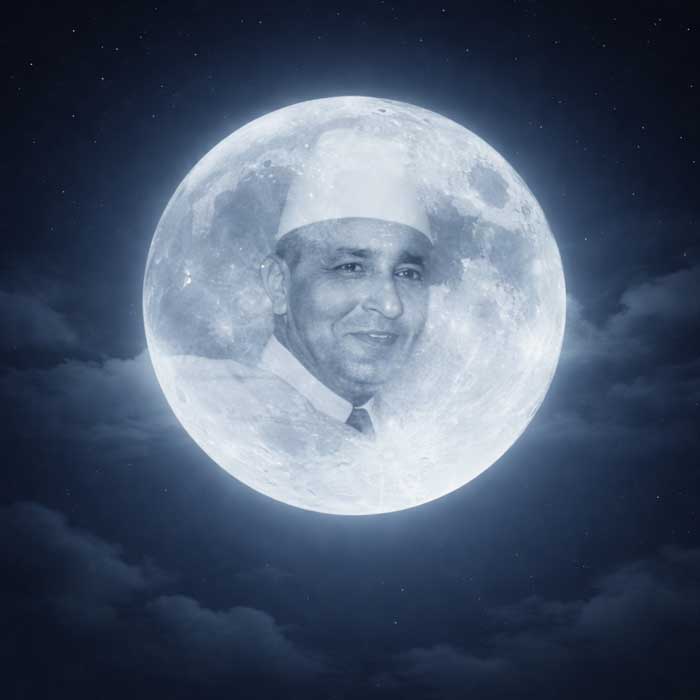
When Moroccan grandparents spoke of seeing His Majesty King Mohammed V in the moon, they were not claiming a physical image. They were expressing admiration, affection, and deep national respect through symbolism. In the desert, where light and shadow shape everything, the moon became a mirror for collective memory, a way to honor a leader whose presence still lives in stories passed from one generation to the next.
The Moon in Moroccan Cultural Imagination
For generations, the moon has held a special place in Moroccan daily life. Long before modern calendars and electric lighting, people relied on the moon to mark time, guide travel, and organize important moments such as planting seasons and religious observances. Watching the moon was not an occasional act—it was a habit shaped by necessity and tradition.
In villages, deserts, and mountain regions, evenings often unfolded outdoors. Families gathered after sunset, and the moon became a natural companion to conversation and reflection. Its changing phases were carefully noticed, discussed, and remembered. The moon was not distant or abstract; it was familiar, present, and quietly influential.
Within this cultural imagination, the moon also became a space for symbolism. Light and shadow formed shapes that invited interpretation, especially in places like the Sahara where the sky appears closer and clearer. In such moments, the moon was more than a celestial body—it was a canvas on which memory, respect, and storytelling could naturally appear.
What Our Grandparents Used to Say
In many Moroccan families, stories were not written down; they were spoken, usually at night. Grandparents would sit outside their homes or tents, under the open sky, sharing memories while the moon quietly watched over them. These moments were unhurried, shaped by silence as much as by words.
When elders said that they could see His Majesty King Mohammed V in the moon, it was spoken with warmth and reverence. The expression did not invite debate or explanation. It was a poetic way of keeping his presence alive, an image shaped by respect, loyalty, and gratitude for a leader who marked an important chapter in Morocco’s history.
Such words were part of a wider tradition of oral storytelling, where meaning mattered more than precision. The moon became a shared reference point, and the story itself became a bridge between generations. What mattered was not what the eye truly saw, but what the heart remembered and chose to honor.
Discover the Magic of Morocco’s December Skies
Who Was His Majesty King Mohammed V
His Majesty King Mohammed V occupies a place of profound respect in Moroccan history. He is remembered not only as a sovereign, but as a symbol of unity, dignity, and resilience during a defining period of the nation’s past. His calm presence and moral authority left a lasting impression on generations who lived through those years.
For many Moroccans, especially elders, Mohammed V represented more than leadership. He embodied hope and continuity at a time when the country needed both. Speaking his name was, and remains, an act of respect, often accompanied by stories that highlight his wisdom, humility, and closeness to the people.
It is within this context that symbolic expressions emerged. Referencing Mohammed V while looking at the moon was never about comparison or likeness, but about remembrance. The moon, constant and quietly luminous, offered a way to reflect on a figure whose legacy continues to guide national memory with dignity and reverence.
Seeing Meaning in Light and Shadow
Human eyes naturally search for patterns. When we look at clouds, rock formations, or the surface of the moon, our minds often connect light and shadow into familiar shapes. This is not imagination in its simplest sense, but a deep human instinct to find meaning in what we observe.
The moon’s surface, marked by darker plains and brighter highlands, becomes especially expressive under clear desert skies. In places like the Moroccan Sahara, where the air is dry and the darkness complete, these contrasts appear sharper and more defined. The moon feels closer, inviting longer and more attentive observation.
Within this quiet setting, meaning emerges naturally. What one person sees may differ from another, shaped by memory, emotion, and cultural background. When elders spoke of seeing His Majesty King Mohammed V, they were responding to this interplay between light, shadow, and remembrance, where the moon becomes less an object of science and more a surface for reflection and respect.
The Desert: Where Stories Feel Closer
The desert has a way of slowing time. Once the sun sets and the heat fades, silence settles over the dunes, broken only by the wind or distant footsteps on sand. In this vast openness, the sky feels wider, deeper, and more present than anywhere else.
Far from artificial lights and distractions, the Sahara restores an older relationship with the night. Stars appear in abundance, and the moon casts a soft glow that shapes the landscape in gentle contrasts. In such an environment, stories do not feel distant or abstract; they feel close, almost alive.
It is here that oral memories find their natural home. The desert amplifies reflection, making it easier to listen, to remember, and to pass stories forward. Under these skies, the words of elders carry more weight, and symbolic expressions, like seeing meaning in the moon, feel less like imagination and more like a quiet conversation between past and present.
targazing Today: Between Science and Story
Modern stargazing brings knowledge that earlier generations did not have. Today, astronomy explains the moon’s craters, its phases, and the way sunlight creates patterns of light and shadow across its surface. Telescopes reveal detail and precision, offering a scientific understanding of what we see above us.
Yet science does not replace story; it simply adds another layer. In Morocco, especially in the desert, stargazing often moves naturally between explanation and memory. A guide may describe the moon’s geography, then pause to share how elders once spoke about it. Both moments belong to the same night sky.
This balance allows tradition and science to coexist with respect. One speaks to the mind, the other to the heart. Together, they remind us that looking at the sky has always been about more than facts alone; it has also been about listening, remembering, and finding meaning in shared human experience.
Passing Stories, Not Facts
Stories like this were never meant to be proven or questioned. They were meant to be shared. When Moroccan elders spoke of seeing His Majesty King Mohammed V in the moon, they were passing on memory, respect, and emotion, not making a statement of fact.
Oral heritage works in a different way than written history or science. It preserves values rather than details, feelings rather than explanations. These stories survive because they carry meaning, not because they demand agreement. Listening to them is an act of respect toward those who came before us.
By understanding these expressions as stories, we protect their dignity. We allow them to exist without judgment, exactly as they were intended, gentle reminders that the night sky has always been a place where memory, identity, and imagination quietly meet.
A Story to Remember Under the Moon
As the moon rises over the desert and light slowly spreads across the dunes, the story naturally returns to silence. There is nothing more to explain, and nothing to prove. What remains is the moment itself, the cool air, the open sky, and the quiet invitation to look up.
In that stillness, each person sees something different. Some notice craters and shadows, others feel calm or nostalgia, and some remember words once spoken by grandparents under similar skies. The moon becomes a shared experience, shaped by both observation and memory.
This is the essence of the desert night story. The moon does not offer answers; it offers space for reflection, for respect, and for connection. And in that space, the legacy of His Majesty King Mohammed V lives on, not as an image in the sky, but as a memory carried gently from one generation to the next.