

Total Lunar Eclipse and Annular or Total Solar Eclipse Explained
The sky has a way of reminding us how small we are, and few events do this better than eclipses. When the Moon slowly turns copper-red during a total lunar eclipse, or when the Sun is transformed into a glowing ring or disappears entirely during a solar eclipse, the experience feels both scientific and deeply emotional. These rare alignments between the Sun, Earth, and Moon have fascinated humans for centuries, inspiring myths, fears, celebrations, and modern scientific discovery.
In this article, “Total Lunar Eclipse and Annular or Total Solar Eclipse Explained,” we’ll break down these breathtaking celestial events clearly and simply. You’ll learn how each type of eclipse happens, what makes them different from one another, and why some are visible to millions while others can only be seen from a narrow path on Earth. We’ll also highlight the eclipse dates happening this year, so you know exactly when to look up and witness these cosmic shows for yourself.
Whether you’re a casual skywatcher or a curious traveler chasing unforgettable natural phenomena, this guide will help you understand and fully appreciate one of nature’s most spectacular performances.
What Is an Eclipse? A Simple Explanation
An eclipse happens when one celestial body moves into the shadow of another. In our case, eclipses involve the Sun, Earth, and Moon, and they occur only when these three align in a very precise way. Depending on which body is blocking the light and where the shadow falls, we experience either a lunar eclipse or a solar eclipse.
1. What Causes Eclipses
- A lunar eclipse occurs when the Earth moves between the Sun and the Moon, casting its shadow on the Moon.
- A solar eclipse happens when the Moon moves between the Sun and the Earth, blocking some or all of the Sun’s light from reaching our planet.
These alignments don’t happen randomly. They require near-perfect positioning, which is why eclipses are relatively rare and exciting events.
2. Why Eclipses Don’t Happen Every Month
You might wonder why we don’t see an eclipse every full or new moon. The reason lies in the Moon’s orbit, which is tilted about 5 degrees compared to Earth’s orbit around the Sun. Because of this tilt, the Moon usually passes above or below the Sun or Earth’s shadow.
Eclipses only occur during special periods called eclipse seasons, which happen about twice a year. During these times, the Sun, Earth, and Moon align closely enough to create lunar or solar eclipses, sometimes even multiple ones in the same year.
Total Lunar Eclipse Explained
A total lunar eclipse is one of the most beautiful and accessible astronomical events, visible to anyone on the night side of Earth where the Moon is above the horizon. Unlike solar eclipses, lunar eclipses are completely safe to watch with the naked eye and unfold slowly over several hours.
1. What Is a Total Lunar Eclipse?
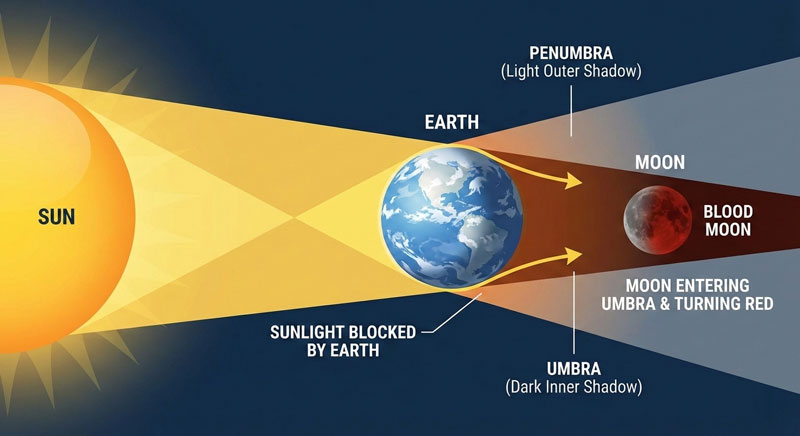
A total lunar eclipse occurs when the Earth passes directly between the Sun and the Moon, causing the Moon to move entirely into Earth’s shadow. This shadow has two parts:
- Penumbra: the lighter outer shadow
- Umbra: the darker central shadow
When the Moon enters the umbra, it gradually darkens. Once it is fully inside this shadow, the eclipse reaches totality.
During totality, the Moon does not disappear. Instead, it often turns a deep red, copper, or orange color, commonly known as a “Blood Moon.” This color comes from sunlight passing through Earth’s atmosphere, where shorter blue wavelengths are scattered and longer red wavelengths are bent toward the Moon.
2. Total Lunar Eclipse Date This Year
Skywatchers can look forward to a total lunar eclipse on March 3, 2026. During this event, the Moon will pass fully through Earth’s shadow, creating a striking Blood Moon visible from large parts of the world, including Asia, Australia, the Pacific, and the Americas.
This eclipse can be enjoyed without any special equipment, though binoculars or a small telescope can enhance the view by revealing subtle color variations and surface details.
Experience the 2026 Eclipses in Morocco with Us!
Solar Eclipse Basics
While lunar eclipses happen at night and are easy to observe, solar eclipses are daytime events that can dramatically transform the sky. Even a partial solar eclipse can noticeably dim daylight, while a total or annular eclipse creates an unforgettable visual experience.
1. What Is a Solar Eclipse?
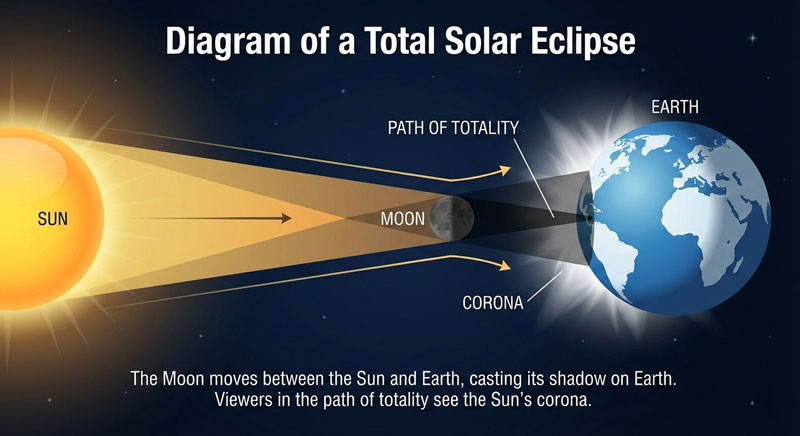
A solar eclipse occurs when the Moon passes between the Earth and the Sun, casting a shadow on part of the Earth’s surface. From certain locations, the Moon appears to block the Sun either partially or completely.
Unlike lunar eclipses, solar eclipses are only visible from specific regions of the world. This is because the Moon’s shadow on Earth is relatively small, creating a narrow viewing path.
2. Types of Solar Eclipses
There are three main types of solar eclipses, each offering a different sky spectacle:
- Partial Solar Eclipse
Only part of the Sun is covered by the Moon. The Sun appears as if a “bite” has been taken out of it. - Annular Solar Eclipse
The Moon is farther from Earth and appears slightly smaller than the Sun. As a result, it does not fully cover the Sun, leaving a bright “ring of fire” visible around the Moon. - Total Solar Eclipse
The Moon completely blocks the Sun, briefly turning day into night along a narrow path called the path of totality. During this moment, the Sun’s outer atmosphere, known as the corona, becomes visible.
Important Safety Note:
Unlike lunar eclipses, solar eclipses must never be viewed directly without proper eye protection, except during the brief total phase of a total solar eclipse.
Annular Solar Eclipse Explained
An annular solar eclipse is one of the most visually striking eclipse types, famous for creating a glowing circle in the sky often called the “ring of fire.” Although it may look similar to a total solar eclipse at first glance, the experience and mechanics are quite different.
1. How an Annular Solar Eclipse Happens
An annular eclipse occurs when the Moon passes in front of the Sun while it is farther away from Earth in its elliptical orbit. Because of this increased distance, the Moon appears slightly smaller than the Sun and cannot completely block it.
As a result:
- The Sun’s center is covered
- A bright ring of sunlight remains visible around the Moon
- The sky darkens slightly, but it does not turn fully night-like
Unlike a total solar eclipse, the Sun’s corona is not visible during an annular eclipse.
2. Annular Solar Eclipse Date This Year
In 2026, an annular solar eclipse will occur on February 17, 2026. This event will be best visible from parts of Antarctica, while surrounding regions may experience a partial solar eclipse.
Eye Safety Reminder:
During an annular solar eclipse, the Sun is never fully covered, so certified solar viewing glasses or filters are required at all times when observing the event.
Total Solar Eclipse Explained
A total solar eclipse is often described as one of the most awe-inspiring natural events on Earth. For a brief moment, the Sun is completely hidden by the Moon, daytime turns into an eerie twilight, and the sky reveals details normally invisible to the human eye.
1. What Makes a Solar Eclipse “Total”?
A total solar eclipse occurs when the Moon passes directly between the Earth and the Sun while it is close enough to Earth to appear larger than the Sun in the sky. This allows the Moon to completely block the Sun’s bright surface, known as the photosphere.
During totality:
- The sky darkens dramatically
- Temperatures may drop slightly
- Stars and planets can become visible
The Sun’s corona, its glowing outer atmosphere, appears as a soft white halo
This phase of totality may last anywhere from a few seconds to several minutes, depending on the observer’s location.
2. Total Solar Eclipse Date This Year
A total solar eclipse will occur on August 12, 2026. The path of totality will pass over parts of the Arctic, Greenland, Iceland, and northern Spain, making Europe one of the best places in the world to witness this rare event.
Observers outside the path of totality will still be able to see a partial solar eclipse, though the full dramatic effect is only visible within the narrow path where the Sun is completely covered.
Viewing Safety Tip:
Outside of totality, solar eclipse glasses are essential. Only during the brief total phase is it safe to view the eclipse without eye protection.
Lunar vs Solar Eclipses: Key Differences
Although lunar and solar eclipses both involve the alignment of the Sun, Earth, and Moon, the experience of witnessing them is very different. Understanding these differences helps skywatchers know what to expect and how to prepare.
Visibility
- Lunar Eclipse:
Visible from anywhere on Earth where it is nighttime and the Moon is above the horizon. One eclipse can be seen by millions of people at once. - Solar Eclipse:
Visible only from specific regions. Total and annular eclipses are limited to a narrow path, while partial eclipses cover a wider area.
Safety
- Lunar Eclipse:
Completely safe to observe with the naked eye at all times. - Solar Eclipse:
Requires certified solar viewing glasses or filters, except during the brief total phase of a total solar eclipse.
Timing and Duration
- Lunar Eclipse:
Develops slowly and can last several hours, with totality lasting up to about 100 minutes. - Solar Eclipse:
Totality or annularity usually lasts only a few minutes, making timing and location crucial.
Visual Experience
- Lunar Eclipse:
The Moon often turns red or orange, creating the famous Blood Moon effect. - Solar Eclipse:
The Sun may appear as a glowing ring (annular) or vanish completely (total), revealing the solar corona.
How to Prepare for an Eclipse (2026 & Beyond)
Experiencing a lunar or solar eclipse can be unforgettable, but a little preparation ensures you get the most out of the event—safely and comfortably.
1. Check the Date and Location
- Total Lunar Eclipse: March 3, 2026 — visible in Asia, Australia, the Americas, and the Pacific
- Annular Solar Eclipse: February 17, 2026 — best in parts of Antarctica
- Total Solar Eclipse: August 12, 2026 — best along the path through the Arctic, Greenland, Iceland, and northern Spain
- Use online eclipse maps and local times to plan your viewing spot.
2. Viewing Equipment
- Lunar Eclipse: No special equipment is required, but binoculars or a small telescope enhance the experience.
- Solar Eclipse: Always use certified solar glasses or solar filters for cameras, telescopes, and binoculars. Never look directly at the Sun without protection.
3. Photography Tips
- Use a tripod for stability.
- Adjust exposure settings for bright or dim phases.
- Capture multiple shots over time to show the eclipse progression.
4. Comfort & Safety
- Bring a blanket or chair if watching from a park or open area.
- Dress for the weather; some eclipses occur at night or in colder regions.
- Keep snacks, water, and a flashlight handy for longer events.
5. Plan Ahead
- Popular viewing areas can get crowded, especially for solar eclipses.
- Consider travel arrangements and accommodations well in advance.
- Join local astronomy clubs or guided eclipse tours for expert guidance.
By preparing in advance, you’ll not only see the eclipse safely but also create memorable experiences to share with friends and family.
Fun Facts & Cultural Significance of Eclipses
Eclipses have fascinated humans for thousands of years, inspiring myths, rituals, and scientific discovery. Beyond their scientific wonder, they hold cultural and historical significance across the globe.
1. Lunar Eclipse Fun Facts
- A “Blood Moon” is caused by sunlight scattering through Earth’s atmosphere, creating a red or copper hue.
- Ancient civilizations often saw lunar eclipses as omens or messages from the gods.
- Lunar eclipses are frequent enough that some cultures developed precise calendars based on them.
2. Solar Eclipse Fun Facts
- The solar corona, visible only during totality, was crucial in early astronomy to study the Sun’s atmosphere.
- Historically, solar eclipses were sometimes feared as portents of major events or disasters.
- Modern eclipse chasers, called umbraphiles, travel worldwide to witness totality and annularity.
3. Eclipses in Modern Culture
- Eclipses inspire photography, art, literature, and even tourism.
- Many festivals and community events are held to celebrate these rare celestial shows.
- Experiencing an eclipse can be both scientifically educational and spiritually moving, reminding us of our place in the universe.
Don’t Miss the 2026 Eclipses
Eclipses are nature’s most dramatic celestial performances, combining science, beauty, and a sense of wonder. Whether it’s the red glow of a total lunar eclipse, the ring of fire in an annular solar eclipse, or the brief darkness of a total solar eclipse, each event offers a unique experience that connects us to the cosmos.
In 2026, the skies give us the perfect opportunity to witness all three spectacular events:
- Annular Solar Eclipse: February 17, 2026
- Total Lunar Eclipse: March 3, 2026
- Total Solar Eclipse: August 12, 2026
Don’t just watch from indoors, plan, gather your friends or family, and experience these eclipses safely. Whether you’re a seasoned astronomer or a curious skywatcher, these rare celestial events are moments you’ll remember for a lifetime.