
When to See Shooting Stars in Morocco (MeteorShowers Calendar)
Have you ever dreamed of standing in the middle of a silent, vast desert, looking up to see dozens of blazing
cosmic trails streaks across the night sky? Morocco, with its expansive skies and minimal light pollution in the
south, has quickly grown into a world-class destination for astro-tourism. Whether you are an avid star-hunter or a
romantic traveler seeking an unforgettable night, understanding when and where to look up is the secret to catching
nature’s greatest light shows.
This comprehensive guide will walk you through the essential mechanics of cosmic dust streams, outline the most
prolific annual meteor displays, and reveal the absolute best locations in Morocco to witness them. By aligning
your travel dates with astronomical cycles, you can transition a standard vacation into a breathtaking celestial
adventure across the Moroccan Sahara.
Understanding Meteors in the Moroccan Sky
To fully appreciate the celestial canvas of North Africa, it helps to understand what a meteor actually is. As Earth
moves along its orbital path, it regularly encounters streams of debris left behind by passing comets or fragmenting
asteroids. When these particles enter our planet’s atmosphere at extreme velocities, the friction generates immense
thermal energy, causing the particle to vaporize and illuminate into what we call a shooting star.
The rate of visible entries can be mathematically modeled based on the spatial density of the debris cloud. The
Zenithal Hourly Rate (ZHR) represents the maximum number of meteors an observer would see under a perfectly
clear, dark sky with the radiant point directly overhead. This value can be expressed through the relationship:
ZHR = (N × F) / (sin(h) × t)
Where N is the number of meteors observed, F represents the atmospheric correction factor, h is the altitude of the
radiant point in the sky, and t is the exact observation time in hours. In the unpolluted expanses of the Moroccan
desert, your practical viewing numbers approach this ideal mathematical threshold much closer than anywhere in
Europe.
The Ultimate Morocco Meteor Shower Calendar
While sporadic meteors can be spotted on any clear night in Morocco, your odds multiply exponentially if you plan
your trip around the major annual celestial events. Below is the active calendar for maximizing your chances.
| Meteor Shower | Peak Activity Period | Expected ZHR | Best Sahara Conditions |
| Lyrids | April 21 – 22 | 15 – 20 | Warm spring nights, clear horizons |
| Perseids | August 11 – 13 | 100+ | Peak summer, warm midnight viewing |
| Orionids | October 21 – 22 | 20 – 25 | Excellent autumn temperatures |
| Geminids | December 13 – 14 | 120+ | Cold winter nights, crisp and clear skies |
The Summer King: The Perseids (August)
The Perseids are arguably the most popular meteor shower for travelers visiting Morocco. Produced by debris from
Comet Swift-Tuttle, this event yields bright, fast meteors. Because August brings warm nights to the desert,
observers can comfortably lay outside on carpets all night without freezing, making it highly accessible for casual
stargazers.
The Winter Giant: The Geminids (December)
If you don’t mind the plunging winter temperatures of the desert, the Geminids offer the most spectacular
performance of the year. With a ZHR often exceeding 120 meteors per hour, this shower features rich, deeply
colored streaks fueled by the rocky asteroid 3200 Phaethon. The atmosphere in December is exceptionally dry and
stable, offering unparalleled visual clarity.
Best Spots in Morocco for Shooting Stars
Location is just as vital as timing. To experience these events to their fullest potential, you must escape urban
centers. The Bortle Dark-Sky Scale ranks locations from 1 (pristine dark sky) to 9 (inner-city sky). The deep
Moroccan Sahara regularly hits a perfect Bortle Class 1.
Erg Chebbi (Merzouga): Famous for its massive golden sand dunes, this area offers luxurious eco-camps
specifically tailored for nighttime observation away from village lights.
Erg Chigaga (Zagora): Even more remote and wild than Merzouga, reaching this spot requires a 4×4 journey,
guaranteeing absolute darkness.
The High Atlas Mountains (M’goun / Oukaïmeden): High elevation translates to less atmospheric distortion,
making mountain clearings exceptional for spring meteor showers.
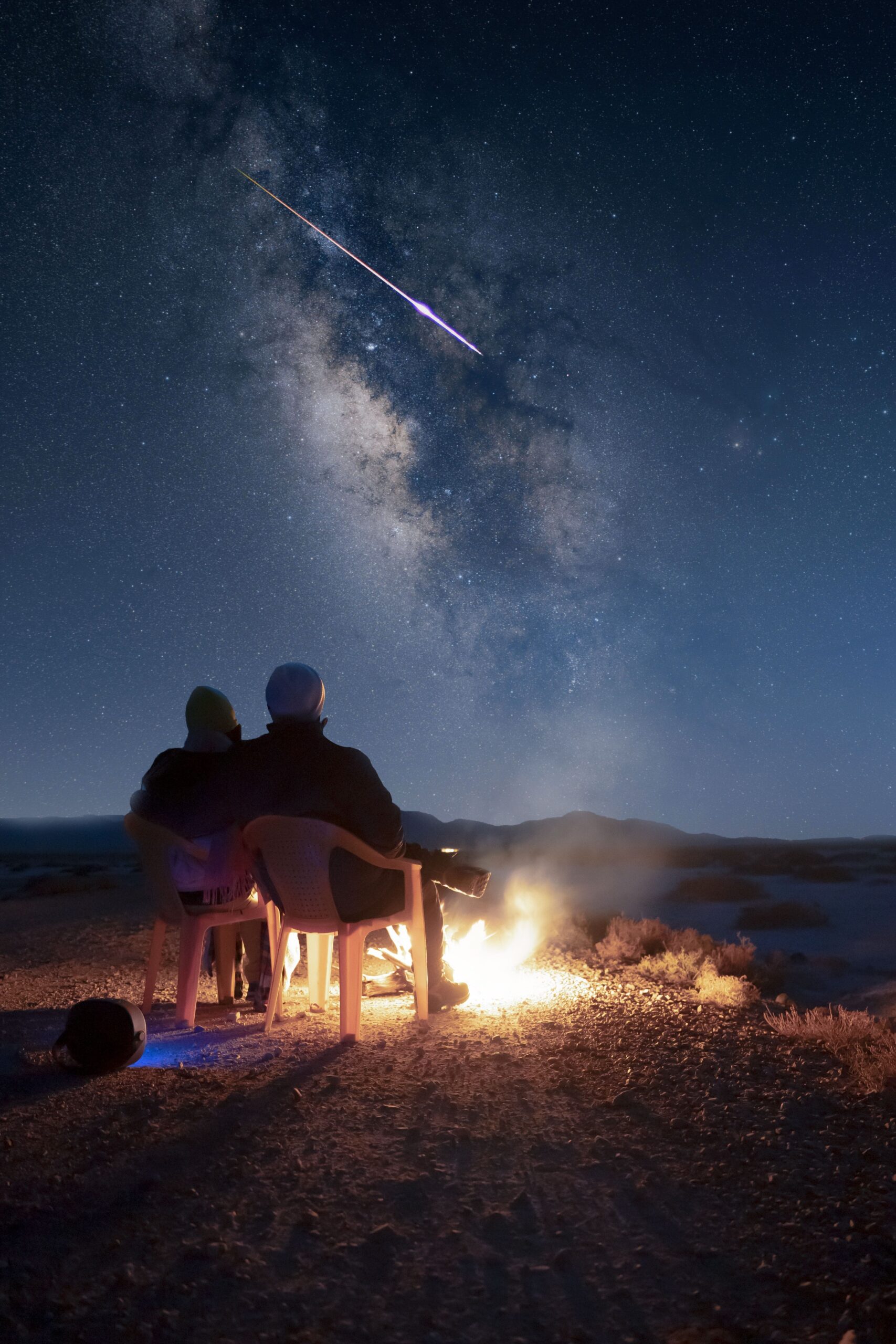
Expert Astro-Tourism Tip
Always check the lunar calendar before booking your flights. Even if you arrive exactly during the Perseid
peak, a bright Full Moon will wash out the fainter trails, cutting your visible shooting stars by over 70%.
Target the New Moon phase
Discover the Stars Like Never Before – Stargaze in Morocco!
targazing in Morocco is more than simply watching the stars—it’s an unforgettable experience in the heart of the Sahara Desert. Far from city lights, you’ll discover one of the world’s clearest night skies while expert local guides reveal the stories, constellations, and traditions that have shaped Morocco’s rich astronomical heritage.
Pro Tips for Astrotourists in Morocco
To ensure your night under the stars is magical rather than uncomfortable, keep these basic guidelines in mind:
Allow Dark Adaptation: It takes your human eyes roughly 20 to 30 minutes to adjust fully to the pitch black.
Put away your smartphones and avoid using white flashlights.
Use Red Headlamps: Red light does not disrupt your night vision or reset your eyes’ adaptation process.
Dress in Layers: The desert experiences extreme thermal shifts. A scorching 40°C day in August can drop
surprisingly fast at night due to the low humidity and lack of cloud insulation.
Real Example: A Magical Night in Erg Chebbi
In August, a group of travelers booked an eco-trek with Morocco Astro Tours specifically to witness the Perseid
meteor shower peak. Positioned deep within the dunes of Erg Chebbi, away from local hotels, the group rested on
traditional wool carpets surrounded by professional telescopes. During the peak hours between 2:00 AM and 4:30
AM, our guests logged an astonishing average of 85 clear shooting stars per hour, including multiple brilliant green
fireballs that illuminated the entire dune ridge line.
Common Mistake to Avoid
Don’t spend your whole night staring through a telescope lens if your goal is to see shooting stars. Telescopes
narrow your field of view tremendously. Meteors are best appreciated with the naked eye, looking broadly at
the sky
Frequently Asked Questions (FAQ)
Do I need expensive equipment to see shooting stars in Morocco?
No, absolutely not. Meteor showers are best enjoyed with the naked eye because they cross wide fields of the sky.
A comfortable reclining chair or mat is far more valuable than a telescope for this specific activity.
Is it safe to sleep out in the open desert to watch meteors?
Yes, when organizing your trip through licensed operators like Morocco Astro Tours, you will stay at secure, fully
managed desert camps with experienced local guides who ensure complete safety throughout the night.
Catching a shower of shooting stars over the timeless dunes of the Sahara is an experience that stays with you
forever. By referencing this calendar and selecting a truly dark sky location, you set the stage for an extraordinary
adventure. Ready to witness the cosmos like never before? Contact our specialized team at Morocco Astro Tours to
book your tailor-made night under the stars.